
If you’re one of the 7 million federal student loan borrowers who were enrolled in the SAVE plan, you’ve just lost your repayment safety net. Here’s what’s really happening, what deadlines you can’t afford to miss, and why private student loan refinancing deserves a serious second look.
The March 2026 Ruling That Changed Everything
On March 10, 2026, the U.S. Court of Appeals for the Eighth Circuit officially eliminated the SAVE plan — the Biden-era income-driven repayment program that offered the lowest monthly payments of any federal repayment option in history. The court reversed a lower court’s dismissal and ordered a settlement between the Trump administration and the state of Missouri to be entered as final judgment.
What does that mean in plain English? The Department of Education must:
- Stop enrolling any new borrowers in SAVE and deny all pending applications
- Transition all current SAVE borrowers into other repayment plans
- Loan forgiveness is no longer an option under SAVE’s provisions
- Pursue formal rulemaking to repeal the SAVE Plan Final Rule entirely
What Else is Changing for Federal Student Loan Borrowers?
The elimination of the SAVE plan is just one piece of a much larger puzzle. The One Big Beautiful Bill Act (OBBBA), signed by President Trump in July 2025, is reshaping the federal student loan landscape. Here’s what’s changing and when:
Starting July 1, 2026:
- Grad PLUS loans are eliminated for new borrowers. New borrowing caps are $20,500 per year for graduate students and $50,000 for professional students.
- Parent PLUS loans are capped — and new Parent PLUS borrowers will lose access to income-driven repayment plans.
- Repayment plans will be streamlined, phasing out PAYE, ICR, and SAVE plans. Only IBR survives for existing borrowers, and the new Repayment Assistance Plan (RAP) becomes the sole income-driven option for new loans.
- Potential loan forgiveness takes longer. RAP requires 30 years of payments before forgiveness kicks in — up from 20-25 years under previous IDR plans.
- As of January 1, 2026, student loan forgiveness is taxable again. The temporary tax exemption on forgiven student loan debt expired at the end of 2025.
Starting July 1, 2027:
- Deferment and forbearance options shrink. New borrowers will no longer qualify for economic hardship or unemployment deferments. Forbearance will be capped at nine months in any two-year period, down from 12 months at a time.
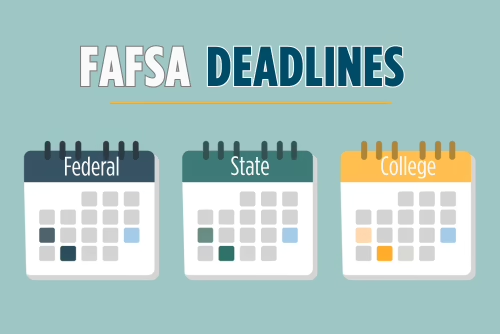
Important Dates You Can’t Afford to Miss
April 1, 2026 — Parent PLUS Consolidation Applications
If you hold Parent PLUS loans, the federal government recommends submitting your consolidation application by April 1, 2026, to ensure it’s processed before the July 1 deadline. Consolidating into a Direct Consolidation Loan before July 1 allows you to retain access to income-driven repayment plans — including IBR and eventually RAP. Miss this window, and your Parent PLUS loans will be locked out of income-driven repayment.
July 1, 2026 — The IDR Cutoff
Borrowers who take out any new federal loan after July 1, 2026, will lose access to existing IDR plans. If you already hold loans and borrow after this date, all of your loans, including older ones, may become ineligible for traditional IDR plans.
July 1, 2028 — PAYE and ICR Phase-Out
If you’re currently on PAYE or ICR, you’ll need to switch to IBR or RAP by this date. Otherwise, your loan servicer will auto-enroll you.
Why Refinancing Deserves a Fresh Look Right Now
For years, the common guidance was to avoid refinancing federal student loans because of the valuable protections they offer—like income-driven repayment, forbearance, and loan forgiveness. That guidance still matters, but the landscape is changing. While it’s still important to consider the potential perks of federal student loans (such as Public Service Loan Forgiveness, or PSLF), shifts to repayment programs including fewer income-driven options for new borrowers and longer forgiveness timelines may make it worth taking a fresh look at how your current loans fit into your overall financial plan. For borrowers with stable income and strong credit, refinancing is becoming a more relevant option to consider.
Student loan refinance rates have also become more attractive recently. While the Federal Reserve held rates steady at its March 2026 meeting, that follows several rate cuts in late 2025 that are still influencing lending markets today.
Private lenders—including many not-for-profit credit unions—adjust their rates based on these broader trends. If you have strong credit, reliable income, or a creditworthy cosigner, you may be able to secure a lower rate than what you’re currently paying.
What Refinancing Won’t Do (And When to Think Twice)
Refinancing isn’t right for everyone, and it’s important to understand what you’re trading:
- If you’re pursuing PSLF: You must have federal loans to qualify for Public Service Loan Forgiveness. Do not refinance if you’re working toward PSLF — unless you’ve already maxed out your forgiveness benefits. Learn more about choosing a repayment plan.
- If your income is unstable: Federal loans (even under the new RAP) offer income-driven payments. If your income fluctuates significantly, maintaining some federal loans may provide a safety valve.
- If you need forbearance frequently: While federal forbearance options are shrinking, they still exist for now. Private lenders vary in what hardship options they offer.
That said, if you have consistent income, strong credit, and don’t plan to use PSLF or IDR forgiveness, refinancing can be a powerful way to reduce your monthly payment or pay off your loans faster — especially in today’s rate environment.
Your Spring 2026 Action Checklist
Here’s what you should do this month:
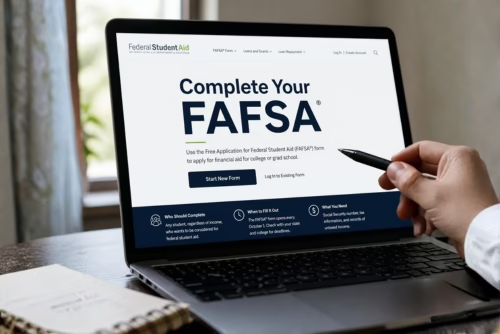
- Review your current loan portfolio. Log in to StudentAid.gov and review your loan types, interest rates, and repayment plan status. Know exactly what you’re working with.
- If you’re on SAVE, switch to IBR. File an Income-Driven Repayment Plan Request and select IBR. Every month you stay in forbearance is a month of accruing interest with no credit toward forgiveness.
- If you have Parent PLUS loans, consolidate NOW. Consolidation takes 4-6 weeks, and missing the July 1, 2026, cutoff means permanently losing IDR access.
- Check your refinance rate — without hurting your credit. See what rate you’d qualify for and compare it to what you’re currently paying.
- Compare credit union refinancing options. Not-for-profit credit union lenders often offer lower rates and more borrower-friendly terms than national for-profit lenders.
- Run the numbers on your specific situation. Consider whether you’d benefit from a shorter term (to save on total interest) or longer term (to lower monthly payments). Even a modest rate reduction can save thousands over the life of your loan.
The Bottom Line
The student loan landscape looks quite different than it did even a year ago. That doesn’t mean you should refinance blindly — it means you should investigate your options now, while rates are favorable and before the July 2026 changes take full effect.
Credit Union Refinance Solutions
If you’re considering student loan refinance, use our finder tool to check rates from leading credit unions. It takes minutes, won’t affect your credit, and could save you in the long run.
*Important: Please remember that federal loans do offer certain benefits and protections that do not transfer to a private loan. By refinancing your federal student loans to a private loan you will lose any federal benefits that may apply to you. Please review this important disclosure for more information.
Loans subject to credit approval and additional criteria. Carefully consider whether consolidating your existing student loan debt is the right choice for you. Any reduction in your monthly payment may result from a lower interest rate, a longer repayment term, or both. Extending the loan term could increase the total interest paid over time.