Here’s something most borrowers discover too late: the difference between a 720 and a 780 credit score on a $40,000 student loan can sometimes mean thousands of dollars in total interest over the loan’s life.
Federal student loans don’t use traditional credit underwriting (except for PLUS loans, which require that you do not have an “adverse credit history”). But private student loans absolutely do. Your credit profile determines whether you’re approved, what rate you receive, and sometimes whether you need a cosigner at all.
Understanding this before you apply gives you the power to improve your position.
How Lenders Use Your Credit Score
Private student loan lenders use your credit score (along with income, debt-to-income ratio, and other factors) to assess risk. Higher scores signal lower risk, which often translates to lower rates.
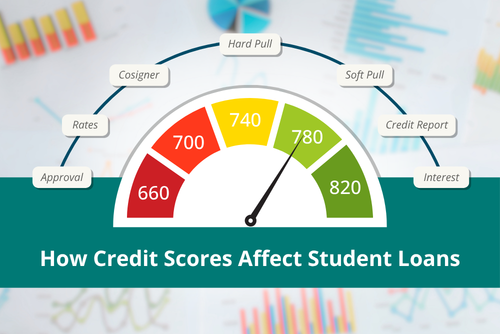
Here’s a rough framework of how credit tiers typically affect private student loan rates:
760 and above (Excellent): You’ll generally qualify for the best advertised rates. This is the tier where lenders compete hardest for your business.
720 to 759 (Very Good): Still competitive rates, usually within about 1 percentage point of the lowest advertised rate. Most borrowers in this range are approved without issues.
680 to 719 (Good): Rates start climbing. A cosigner with a higher score can significantly improve your offer in this range.
640 to 679 (Fair): Approval is possible but rates will be higher. A cosigner is often beneficial here.
Below 640: Many private lenders have minimum thresholds in this range. A cosigner with strong credit may improve your chances of approval.
Note: these are general patterns, not guarantees. Every lender has its own underwriting criteria.
Five Things to Do Before You Apply
1. Check Your Credit Reports (All Three)
Before any lender sees your credit, you should see it first. Pull your free reports from AnnualCreditReport.com (the only federally authorized source) from Equifax, Experian, and TransUnion.
Look for: errors (wrong accounts, incorrect balances, accounts you don’t recognize), late payments you believe were on time, and collections that shouldn’t be there. Disputing errors can take several weeks, so start now.
For step-by-step instructions: How to Check Your Credit Score for Free.
2. Pay Down Revolving Balances
Your credit utilization ratio (how much of your available credit you’re using) is the second-biggest factor in your credit score after payment history. Keeping utilization below 30% is good. Below 10% is better.
If you have a credit card with a $5,000 limit and a $2,500 balance, that’s 50% utilization, which is dragging your score down. Paying it to $500 (10% utilization) may improve your score, sometimes within one or two billing cycles depending on your profile.
This is often one of fastest ways to improve your credit score before applying for a loan.
3. Don’t Open New Credit Lines
Every new credit application creates a hard inquiry on your report, which temporarily lowers your score by a few points for a period of time. It also reduces your average account age, another scoring factor.
In the two to three months before applying for a student loan, avoid opening new credit cards, auto loans, or retail store accounts. The marginal benefit isn’t worth the score hit.
For more on how inquiries work: Hard vs. Soft Credit Pull: Why It Matters.
4. Become an Authorized User
If a parent or family member has a credit card with a long history and low utilization, being added as an authorized user can boost your score by inheriting that account’s positive history. You don’t even need to use the card.
This is especially useful for students with thin credit files (fewer than 3 to 4 accounts). The additional account adds depth and history that lenders want to see.
5. Consider a Cosigner Strategically
If your credit score puts you in a higher rate tier, a cosigner with excellent credit can help you qualify for a lower rate or improve approval odds. On a $30,000 loan, the difference between a cosigner-assisted 5.5% rate and a solo-applicant 8.5% rate can be several thousand dollars over 10 years.
That’s a meaningful financial decision. Have an honest conversation with your potential cosigner about the commitment and the plan for how cosigning works and when release is possible.
The Federal Loan Baseline
Remember: federal Direct Loans for undergraduates don’t require a credit check at all. The 6.52% fixed rate for 2026-27 applies to every eligible borrower regardless of credit score. That’s the beauty of federal loans.
Credit score only enters the picture for:
- Federal PLUS Loans (parent or graduate): require no “adverse credit history” (defaults, bankruptcy, recent delinquency)
- Private student loans: credit score directly affects approval and rate
- Refinancing: credit score is a primary factor in the rate you receive1
Timing Your Application
Credit scores fluctuate monthly as new data reports. If you’re planning to apply for a private student loan or refinance in the next 60 to 90 days:
- Pull your reports now.
- Dispute any errors immediately.
- Pay down credit card balances this month.
- Avoid new credit applications.
- Check your score again after updated information reports (around 30 days) to confirm improvement.
Then compare rates when your score is at its best. A few weeks of preparation can save thousands over the life of the loan.
If you’re weighing whether student loan refinancing makes sense for your situation, here’s an honest breakdown of when it helps and when it hurts.
1 Federal Benefit Loss Disclaimer: Remember that by refinancing federal student loans, you will lose certain borrower benefits from your original loans. These may include interest rate discount, principal rebates, or some cancellation/forgiveness benefits that can significantly reduce the cost of repaying your loans. Please consider these benefits carefully when considering your options for refinancing federal student loans.