Quick quiz: would you rather have a student loan at 5.5% or one at 6.0%?
Most people instinctively pick 5.5%. But what if the 5.5% loan has a 4% origination fee, a 20-year term, and no autopay discount? And the 6.0% loan has zero origination fee, a 10-year term, and a 0.25% rate reduction for automatic payments?
The 6.0% loan in this example costs less. Significantly less.
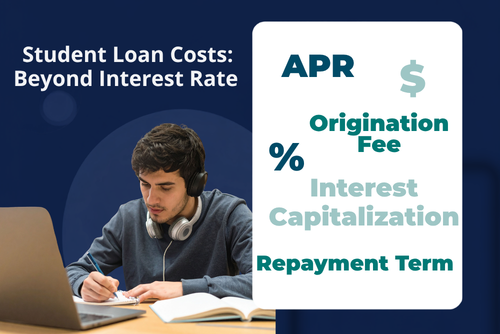
Interest rate gets all the attention because it’s simple: lower number good, higher number bad. But student loans have at least five other numbers that affect what you actually pay. Ignoring them is like buying a car based solely on horsepower.
Number 1: The Annual Percentage Rate (APR)
The Annual Percentage Rate includes your interest rate plus most fees, expressed as an annual cost. It’s the best single estimate of a loan’s annual cost.
Federal student loans have origination fees, so their APR is typically higher than the stated interest rate. For example, Federal Direct Loans for undergraduates first disbursed on or after July 1, 2026, and before July 1, 2027, carry a 6.52% interest rate – but with the 1.057% origination fee factored in, the APR is slightly higher than the stated interest rate. Federal Parent PLUS loans are even more dramatic: a 9.07% interest rate with a 4.228% origination fee means the APR is meaningfully above the stated rate.
Many private lenders (especially credit unions) charge zero origination fees. So, a private loan at 7.0% with no fees can have a lower APR than a federal PLUS loan at 9.07% with a 4.228% fee.
When comparing loans, compare APRs. It’s the closest thing to an apples-to-apples number.
Number 2: The Origination Fee
An origination fee is generally deducted from your loan before you receive the money. Borrow $10,000 with a 4% fee, and you get $9,600 but owe $10,000 plus interest.
Federal Direct Loans: 1.057% origination fee.
Federal PLUS Loans: 4.228% origination fee.
Many credit union private loans: 0% origination fee.
On a $20,000 PLUS loan, the origination fee alone costs $846 before you make a single payment. That’s money you never received but must repay with interest.
Number 3: The Repayment Term
This is the silent budget killer. Stretching your repayment from 10 to 20 years drops your monthly payment but dramatically increases total cost.
Here’s the math on a $40,000 loan at 7%:
- 10-year term: $465/month, $55,800 total
- 15-year term: $360/month, $64,600 total
- 20-year term: $310/month, $74,400 total
The 20-year option saves $155 per month but costs $18,600 more over the life of the loan. That’s a new car.
Choose the shortest term you can comfortably afford. Your monthly budget will feel tighter, but your total cost will be thousands less.
Number 4: The Autopay Discount
Many lenders offer an interest rate reduction such as 0.25% when you enroll in automatic payments. On a $30,000 loan, that can add up to about $400 in savings over 10 years.
Some credit union lenders offer this discount; it’s worth confirming before you sign. When comparing offers, make sure you’re comparing with the discount applied consistently across all options.
Number 5: Interest Capitalization
When you’re not making payments (during school, grace period, or deferment), interest accrues. At certain points, that unpaid interest may be added to your principal balance. This is called capitalization, and it means you start paying interest that accumulated on interest.
Example: You borrow $25,000 at 7% and choose to fully defer payments. During school, approximately $7,000 in interest accrues. At repayment, the $7,000 in interest is capitalized (added to your balance) and the balance becomes $32,000. Now you’re paying a 7% interest rate on $32,000, not $25,000, increasing your interest costs by roughly $2,800 over a 10-year repayment.
Making payments during school (interest-only or even small payments as you are able) can help reduce or prevent this.
Number 6: Total Cost of the Loan
This is the number that should drive your decision. Total cost = principal + all interest paid + all fees.
Before signing any loan, ask the lender: “What is the total amount I will pay over the life of this loan assuming I make minimum payments?” If they can’t or won’t answer that clearly, that tells you something.
Putting It Together: A Real Comparison
Imagine you need $20,000 for one year of school.
Option A: Federal Parent PLUS
- Rate: 9.07%
- Origination fee: 4.228% ($846)
- You receive: $19,154
- 10-year repayment: $253/month
- Total repaid: ~$30,360
Option B: Private loan through a credit union (with cosigner)
- Rate: 6.5% (hypothetical, depends on creditworthiness)
- Origination fee: $0
- You receive: $20,000
- 10-year repayment: $227/month
- Total repaid: ~$27,240
Option B saves roughly $3,120 and puts $846 more in your pocket on day one. The lower interest rate is part of the story, but the no origination fee and lower total cost are what make the difference meaningful.
Always fully compare rates and terms before committing to a loan.
The Takeaway
Interest rate is one data point. APR, origination fees, repayment term, autopay discounts, and total cost are the rest of the picture. The smartest borrowers compare all six numbers across every option before signing.
If you haven’t already, run through the full pre-signing checklist. And keep the student loan glossary handy for any terms that aren’t clear.