Signing a student loan can feel a lot like signing a lease: you’re making a long-term financial commitment based on a document filled with unfamiliar terms and fine print. It’s easy to focus on the signature line without taking the time to fully understand what’s included.
Before you sign, take a few minutes to review the details so you know exactly what to expect.
Here are 10 things to verify, in order of importance, before you sign any student loan. Federal or private, first loan or fifth.
1. The Annual Percentage Rate (Not Just the Interest Rate)
The interest rate is the number everyone focuses on. The annual percentage rate (APR) is the number that actually matters. APR includes the interest rate plus fees like origination charges, giving you the true annual cost of borrowing.
Federal Direct Loans charge a 1.057% origination fee. That means a $5,500 loan actually disburses about $5,442. Many private lenders charge no origination fees, which can make their effective cost lower than it first appears.
Compare APRs, not just interest rates.
2. Fixed or Variable (And What Happens If Rates Rise)
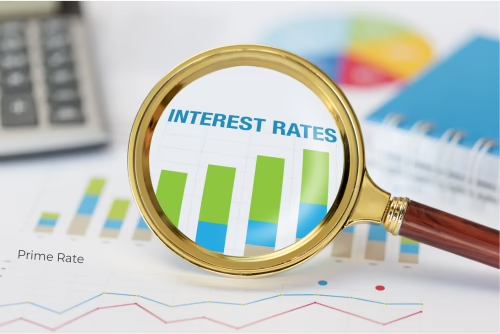
A fixed rate stays the same for the life of the loan. A variable rate can change periodically based on an index, such as the Prime rate.
Variable rates often start lower, which looks attractive. But in a rising-rate environment, a 5.5% variable rate today could climb significantly in two years. Run the math on both scenarios before choosing.
For a full breakdown: Fixed vs. Variable Rate Student Loans: How to Choose When Rates Are Moving.
If you choose a variable rate loan: know the rate cap (the maximum your rate can reach) and how often adjustments happen. If there’s no cap, think twice.
3. The Total Repayment Amount (Not Just the Monthly Payment)
A lower monthly payment sounds great until you realize it means a longer repayment term and significantly more total interest.
Example: $30,000 at 7% fixed over 10 years (120 months) = $348/month and $41,800 in total payment. The same loan stretched to 20 years (240 months) = $233/month but $55,820 in total payment. You’re paying $14,000 more for the privilege of smaller monthly payments.
Ask: what is the total amount I will repay over the life of this loan?
4. When Payments Start (Grace Period Details)
Federal loans typically provide a six-month grace period after graduation. Private loans vary: some offer six months, some offer three, some require payments while you’re still in school.
Know the exact date payments begin. Mark it on your calendar. Set a reminder 60 days before so you can budget.
5. Whether Interest Accrues During School
Subsidized federal loans do not accrue interest while you’re enrolled at least half-time. The government covers it. Unsubsidized federal loans and most private loans accrue interest from the day the money is disbursed.
On a $20,000 unsubsidized loan at 7%, four years of in-school interest accrual adds roughly $5,600 to your balance if you fully defer your loan payments while in school. That’s $5,600 in debt for doing nothing.
If you can afford even small interest payments during school, make them. It saves real money.
6. Cosigner Requirements and Release Options
If a cosigner is helping you qualify or get a better rate, understand their obligation. A cosigner is fully responsible for the loan if you can’t pay. That’s a significant ask.
Many private loans offer cosigner release after 24 to 48 consecutive on-time payments. Be sure you understand the release criteria and understand it is not automatic – you will likely need to submit a release application and will need to qualify for the loan on your own at the time of the release.
More on this: How a Cosigner Changes Everything About Your Private Student Loan.
7. Prepayment Penalties (There Shouldn’t Be Any)
Neither federal nor most reputable private student loans charge prepayment penalties, but verify it. You want the freedom to make extra payments or pay off the loan early without being charged for the privilege.
If a loan has a prepayment penalty, that’s a red flag.
8. Deferment and Forbearance Options
Life happens. Job loss, medical issues, economic downturns: you need to know what protections exist before you need them.
Federal loans offer income-driven repayment plans, economic hardship deferment, and forbearance options. Private loans vary widely. Some offer 12 months of forbearance over the loan’s life. Some offer almost nothing.
Ask: what are my options if I can’t make payments for a period of time?
9. The Loan Servicer (Who You’ll Actually Deal With)
Your lender and your loan servicer are often different entities. The servicer is who you make payments to, who you call with questions, and who can make your life easier or harder.
Check reviews of the servicer. Federal loan servicers have varying reputations. Private lenders that service their own loans (many credit unions do) often provide better customer experience because they’re accountable for the full relationship.
10. How This Loan Fits Your Total Borrowing Plan
One loan is manageable. Four years of one loan each year adds up. Before signing, calculate your total projected borrowing across all years and estimate your monthly payment at graduation.
The general guideline: total student loan debt should not exceed your expected first-year salary. If you’re borrowing $160,000 for a degree that leads to a $45,000 starting salary, the math doesn’t work regardless of the interest rate.
Print This. Check Every Box.
Before signing any student loan, review:
- APR confirmed (not just interest rate)
- Fixed vs. variable decision made with full scenario analysis
- Total repayment amount calculated
- Grace period and payment start date known
- Interest accrual during school understood
- Cosigner terms and release options verified
- No prepayment penalties confirmed
- Deferment/forbearance options documented
- Loan servicer reviewed
- Total borrowing plan fits salary expectations
If any of these items aren’t clear, ask your lender before you sign. Not after.
Need to compare credit union rates before you commit? That’s smart. And if your summer action plan needs updating, now’s the time.